


Our bodies know when we're lost before our minds admit it.
There's a specific sensation that arrives when orientation fails, when the familiar markers dissolve and we realise we have no idea which way leads out. It's not panic exactly, though panic can follow. It's something quieter and more ancient: the nervous system registering its inability to locate safety, predict what comes next, or find the thread back to solid ground.
Hope, in those moments, is not the greeting card version. It is not positive thinking or vision boards or deciding to believe everything will work out. Hope is a survival tool, and it functions like one. It is the biological imperative to keep scanning the horizon for something, anything, that resembles direction.
When we talk about seeking hope, we're talking about the body's refusal to stop looking for light.
The Nervous System and the Dark
Darkness isn't metaphorical when we're in it. It's a physical state that the nervous system responds to with measurable changes, including heart rate variability shifts and rising cortisol. The amygdala stays active and vigilant. We are wired to track light because light means information, and information means the possibility of navigation.
The absence of light removes one of our primary tools for orientation. We lose spatial awareness, and we lose the ability to judge distance or identify threats. Our bodies compensate by heightening other senses, but something else happens too: we become hypersensitive to even the smallest source of illumination.
Physiologically, hope can be the smallest shift from drifting to locating. The nervous system keeps scanning for something to anchor to, something that signals direction or the potential for movement. A pinpoint of light in total darkness becomes disproportionately significant because it offers a reference point.
Hope as Orientation
Seeking Hope isn't about rescue. It's about finding enough light to take the next step, then the one after that, without pretending we can see the whole road.
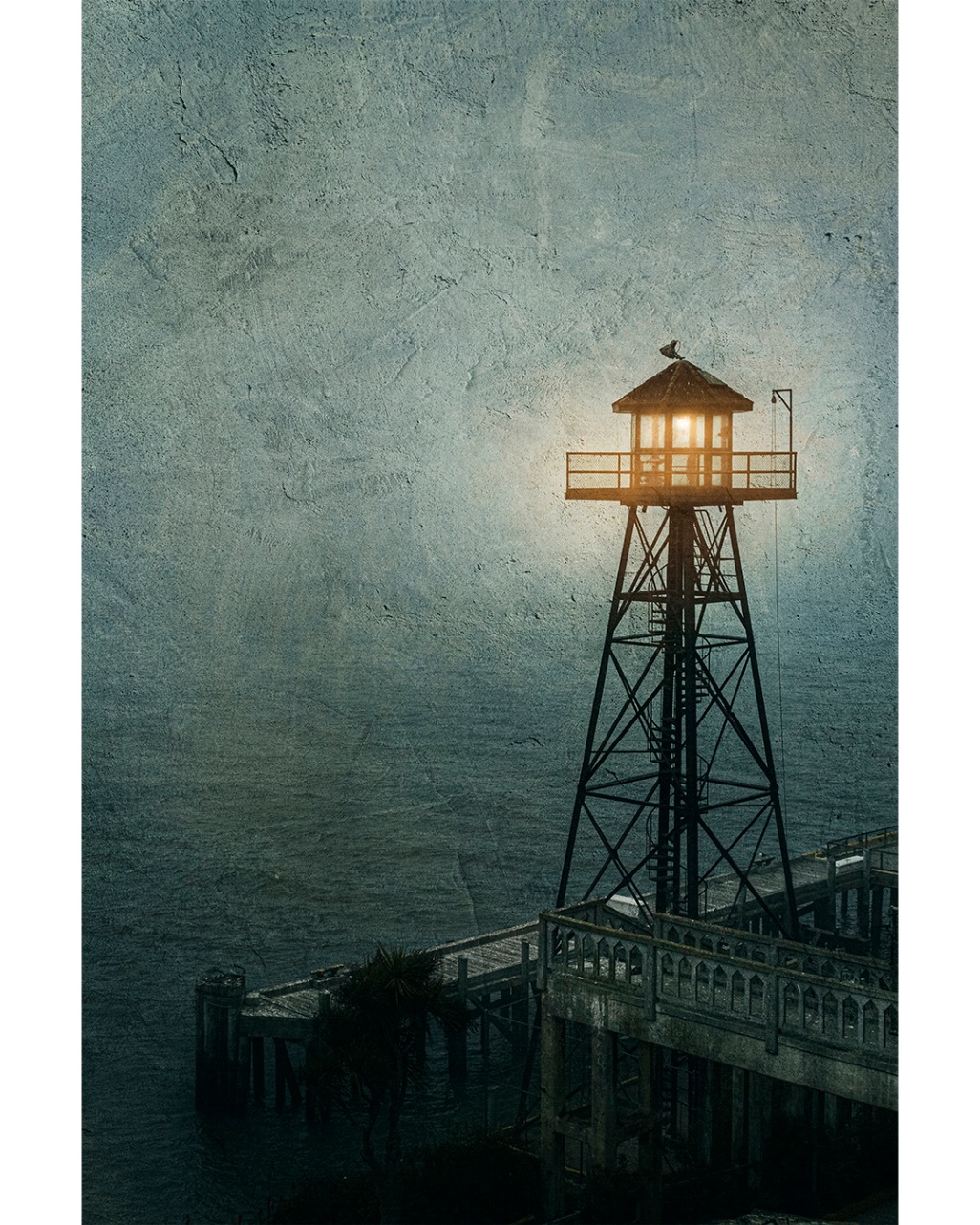
The lighthouse in this work doesn't promise safety or arrival. It promises something more fundamental: orientation. It says, "Here is a fixed point. Here is something we can navigate by." The beam cuts through the dark not to eliminate it, but to create relationship with it, to give the darkness context and the body a way to measure distance.
When we lose direction in our lives, whether through grief or trauma or the slow erosion of the structures we built our identity around, the need for orientation becomes visceral. We're not looking for someone to tell us everything will be fine. We're looking for a single reliable truth we can use to figure out where we are and which way to move.
That's the kind of hope that functions as survival. It's lean and practical, and it doesn't promise more than it can deliver.
The Work of Small Orientations
Finding our way through the dark is repetitive work. We take a step, then we reassess and adjust. Another step follows, and with it another recalibration. We don't get to know the full map before we start walking, and we don't get to skip the discomfort of not knowing whether we're heading in the right direction.
The lighthouse doesn't move toward us. We move toward it, incrementally, through trial and correction. This is where hope becomes something we practise rather than something we feel. It's the decision to keep using the available light even when it reveals how far we still have to go.
Research on finding direction during difficult times confirms what the body already knows: we don't need perfect clarity to move forward. We need something to orient by, even if it's small, even if it only illuminates the immediate next step. The brain processes these small orientations as progress, and progress, however minimal, signals to the nervous system that movement is possible.
Motivation can come and go like weather. Orientation is more like a quiet structure we can touch in the dark. It gives us something to work with.
What the Body Recognises
When we look at Seeking Hope, our bodies might respond before our thoughts do. There's something primally reassuring about a light source in darkness, something that predates language and logic. The nervous system recognises that beam as a signal: direction exists, movement is possible, and we are not entirely without information.
This is wall art that doesn't function as decoration. It functions as a reminder of what the body already knows how to do, which is to keep scanning, keep orienting, keep using whatever light is available to take the next step.
The trees framing the lighthouse create enclosure without claustrophobia, a sense of being held rather than trapped. The stars offer distant reference points, additional orientation. Everything in the composition points toward the question: what do we do when we can't see the whole way forward?
We use the light we have.
The Refusal to Stop Looking
Hope, in its survival form, is the refusal to stop scanning for direction. It's not optimism and it's not faith. It's the biological insistence that orientation matters, and finding one reliable reference point changes what becomes possible next.
The dark doesn't have to disappear for this to work. The dark is part of the equation. It's the darkness that makes the light significant, that gives the lighthouse its function and creates the conditions where hope becomes something we practice with our whole nervous system rather than something we think about.
Seeking Hope holds that paradox: the darkness and disorientation are real, alongside the body's capacity to use even a single point of light to begin navigating. All of it is true simultaneously.
If you have found your way here, there's probably a reason. Maybe you have arrived in a moment that requires this particular kind of orientation, a reminder that hope can be stripped down to its survival mechanics. Maybe your nervous system needs a lighthouse, not as a promise, but as a steady reference point.
For collectors and for spaces that hold tender conversations, there are limited edition prints available, signed and numbered, with only 12 editions of each work. If you feel drawn to live with Seeking Hope as healing wall art, you can spend time with it there.
In Reflection
If the dark has been thick lately, you do not need to force a wide horizon. You only need one honest point of light.
Notice what helps you orient, even briefly. A voice that steadies you. A morning window. A small ritual. A single true sentence you can return to when everything else blurs.
Then take the next step you can actually take. Let that be enough for today.


